First-Time Buyers
Bank vs Credit Union vs Broker: An Honest Take
 Ian Anderson · NMLS ##1849097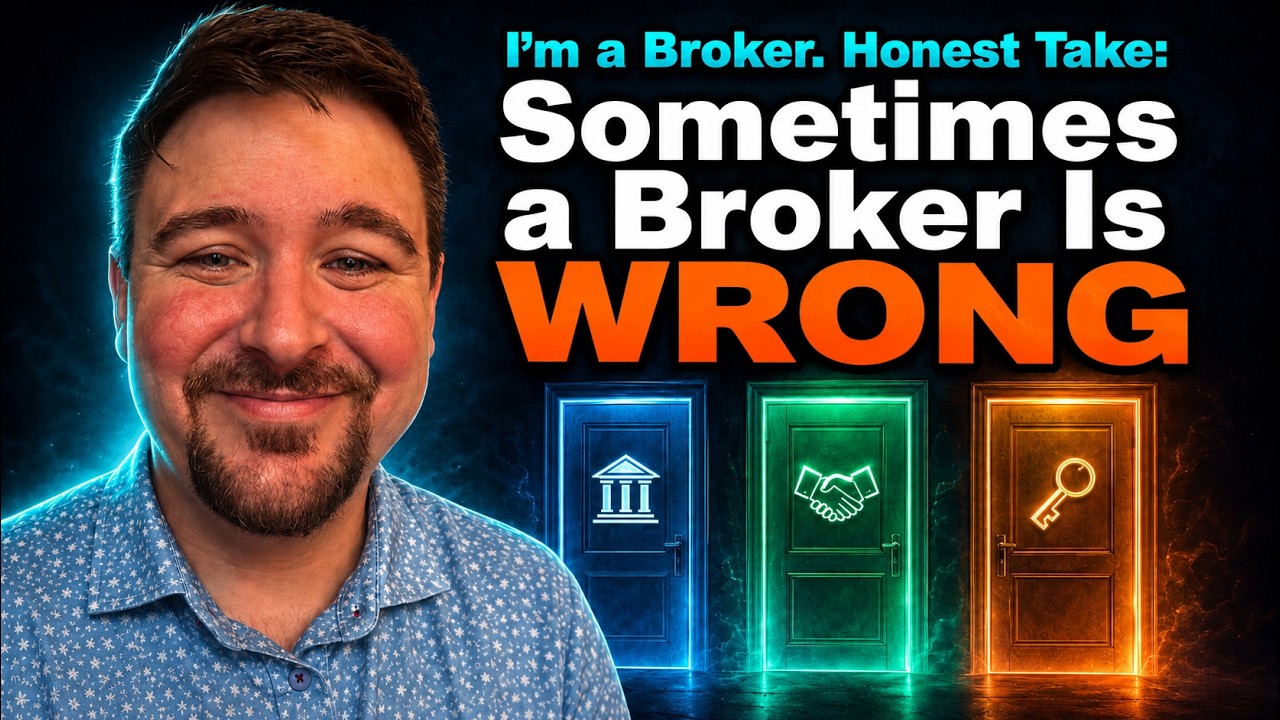
Quick answer
There's no single "best" option — it depends on your situation. Banks can offer convenience if you already have accounts there. Credit unions often have lower fees and rates for members. Brokers, like Fisherman Mortgage Services, shop multiple wholesale lenders on your behalf to find competitive rates and can work with more complex financial situations (self-employed, investor, non-QM). Keep reading for the full breakdown of when each option makes the most sense.
Should I get my mortgage from a bank, a credit union, or a broker?
It depends on what matters most to you. Start with a broker if you want the lowest rate and the flexibility to handle complex income. Choose a bank or credit union if you value simplicity and a branch you can walk into. For a land loan or construction loan, go straight to a local credit union. None of the three is best for everyone. The right one matches your situation.
That one pick can change your rate, your closing costs, and whether your loan even makes it to the closing table. The problem is that almost everyone who answers this question for you is trying to sell you one of the three.
I'm a mortgage broker, so you'd expect me to say a broker is always the answer. I'm not going to do that. There are real situations where a bank or a credit union is the smarter move, and by the end of this you'll know exactly which one fits.
Why aren't banks, credit unions, and brokers the same thing?
These three aren't even competing on the same thing. A bank, a credit union, and a broker are good at three different jobs. When you treat them all as just "places to get a loan," that's how you end up with the wrong one.
So let's break down what each one is actually built for. The good, the bad, and the ugly.
What is a bank good at for a mortgage?
A bank lends you its own money. The biggest thing it gives you is simplicity, plus a place you can actually walk into. You can stroll into a branch, make a payment in person, and if something goes sideways, there's a building with your name on the account. For a lot of people, that peace of mind is worth a lot.
Banks can also be surprisingly strong on a couple of specific things. Jumbo loans, which are simply loans too big for the standard limit, and HELOCs, a home equity line of credit that works like a credit card against your home's equity. If that's what you're after, a bank quote belongs on your list.
Here's the catch. A bank only carries its own products, which usually means fewer programs. Fewer programs means it can be harder to qualify, because if you don't fit their box, there's no plan B. And on the everyday loans most buyers use, such as FHA, VA, USDA, and conventional, a bank often has a harder time coming back with a truly competitive rate.
The lesson is simple. If simplicity and a branch matter most, or you're shopping a jumbo loan or a HELOC, a bank deserves a real look. Just know the menu is narrow.
When is a credit union the best mortgage lender?
A credit union is owned by its members. You're not just a customer, you're a part-owner. In a lot of ways it feels like a bank, with a branch and a physical place to go. But there are a few areas where it genuinely pulls ahead.
Credit unions can be a little better priced on conventional loans. And this is the big one almost nobody mentions. Credit unions are usually where you go for a land loan. If you're buying a raw piece of land, most lenders won't touch it. Credit unions will.
They also tend to be excellent on construction-to-permanent loans, which is the loan you use to actually build a home, and on HELOCs. One more quiet advantage is that credit unions typically don't sell your servicing. The place you mail your payment to usually stays the same for the whole life of the loan, instead of getting handed off to a company you've never heard of. You can learn more about how servicing transfers work at the Consumer Financial Protection Bureau.
Here's the catch. On VA, USDA, and FHA loans, credit unions usually aren't very competitive. A lot of buyers use those programs, so a credit union may not be your best price there.
The lesson: if you want a physical location, or you need a land loan, a construction loan, or a HELOC, get a credit union quote. On those, they're tough to beat.
What does a mortgage broker actually do?
Now the one I'm supposed to be biased about. A mortgage broker doesn't lend their own money. A broker shops your one loan file across a whole network of wholesale lenders and brings back options. So instead of one shelf, you're looking at many shelves at once.
That's exactly why, on most loans, a broker tends to come back with the lowest rate and the lowest closing costs. More shelves means more competition for your loan. It's also why a broker can handle the scenarios nobody else can. Self-employed buyers, a newer business, commission income, the complicated files where a single bank just says no.
Here's the honest downside. A broker is usually a smaller shop. There's no big branch to walk into, and you can't link the loan to your existing bank accounts the way you can with a bank. If a physical location and merging all your accounts under one roof matter to you, a broker probably isn't your fit.
The flip side of being small is that a broker is usually a local business, which means the owner has real skin in the game in making sure your experience is good. With a giant lender, you can feel like a number. With a good broker, you're a client, and their reputation in town is the whole business.
How does a mortgage broker get paid?
If the broker shops it, who's paying the broker? Good question. A broker gets compensated on the loan, and by law that compensation has to be spelled out for you in writing. It shows up on your Loan Estimate and your Closing Disclosure.
It's not a hidden fee buried in your rate that nobody will explain. You should be able to ask any broker, flat out, how they get paid, and get a clear answer. If you can't, that's your sign to walk.
Bank vs credit union vs broker: quick comparison
Let me put it all side by side.
- A bank is simplicity, a branch, and strong jumbo and HELOC options.
- A credit union is that same physical convenience, plus the place to go for land loans, construction loans, and HELOCs.
- A broker is best for the strongest rates, the lowest closing costs, and the flexibility to handle the loans nobody else will, just without a branch.
None of those is "the best." The best one is the one that matches what matters most to you.
What is the one question that picks my lender fast?
Ask yourself this. What matters more to me, the lowest rate and the most flexibility, or simplicity and a place I can walk into?
If it's rate and flexibility, start with a broker. If it's simplicity and a physical location, start with a bank or a credit union. And there's one shortcut that overrides all of it. If you need a land loan or a construction loan, go straight to a local credit union. That's what they do best.
What is the biggest mistake buyers make before picking a lender?
Here's the mistake I see all the time. Buyers pick the lender first and check their qualification second. They fall in love with a name, or a rate they saw in an ad, and only later find out that lender can't actually do their loan.
Do it the other way around. Get a real look at your own situation first, your income, your credit, and your goals, then choose the door that fits. The lender should match you. You shouldn't have to contort yourself to match the lender.
Ready to find out which door is yours?
If your situation isn't simple and you want someone to look at it before you go knocking on the wrong door, that's an easy problem to fix. Book a free strategy call and we'll look at your income, your goals, and your options. I'll tell you honestly which door is yours, even if it's not mine.
Frequently asked questions
Is a mortgage broker always cheaper than a bank? +
Not always, but often. A broker shops your file across many wholesale lenders, which creates competition for your loan and tends to bring back lower rates and closing costs on most everyday loans like FHA, VA, USDA, and conventional. Banks can still be strong on jumbo loans and HELOCs, and credit unions may price conventional loans well. The only way to know your best deal is to compare a few quotes side by side using your actual numbers.
When should I use a credit union for my mortgage? +
A credit union is usually your best move when you need a land loan or a construction-to-permanent loan, since most lenders won't touch raw land. Credit unions also tend to be excellent on HELOCs and can be competitively priced on conventional loans. Another quiet advantage is that they often don't sell your servicing, so the company you pay stays the same for the life of the loan. They are usually less competitive on VA, USDA, and FHA loans.
Do banks offer the best rates on FHA and VA loans? +
Often not. Because a bank only carries its own products, it can have a harder time coming back with a truly competitive rate on the everyday loans most buyers use, including FHA, VA, USDA, and conventional. A broker shopping multiple wholesale lenders, or in some cases a credit union, may beat a single bank's quote on these programs. Always compare more than one option before deciding.
How do I know how my mortgage broker gets paid? +
By law, a broker's compensation must be disclosed to you in writing. It appears on your Loan Estimate and your Closing Disclosure, so it isn't a hidden fee buried in your rate. You should be able to ask any broker directly how they get paid and receive a clear answer. If a broker can't or won't explain their compensation plainly, treat that as a sign to walk away.
What is the biggest mistake home buyers make when choosing a lender? +
The most common mistake is picking the lender first and checking qualification second. Buyers fall in love with a name or an advertised rate, then learn later that the lender can't actually do their loan. Flip the order. Get a real look at your income, credit, and goals first, then choose the lender that fits your situation. The lender should match you, not the other way around.
Should I get a bank or broker for a jumbo loan or HELOC? +
Banks can be surprisingly strong on jumbo loans, which are loans too big for the standard conforming limit, and on HELOCs. Credit unions are also frequently competitive on HELOCs. If either product is what you need, get a quote from a bank and a credit union and compare it against a broker. The right choice depends on the specific terms each one brings back for your situation.
Sources
- Understanding the Loan Estimate — Consumer Financial Protection Bureau
- What is mortgage servicing? — Consumer Financial Protection Bureau
- FHA Loans — U.S. Department of Housing and Urban Development
- VA Home Loans — U.S. Department of Veterans Affairs
About the author
Ian Anderson — President / Sr. Loan Advisor
NMLS ##1849097
Doing loans forever.
Ready to talk numbers?
Schedule a 15-minute call. We'll walk through your situation and show you what's actually possible — no pressure, no pitch.
Book a call