Rates & Costs
FHA vs. Conventional: Which Costs Less?

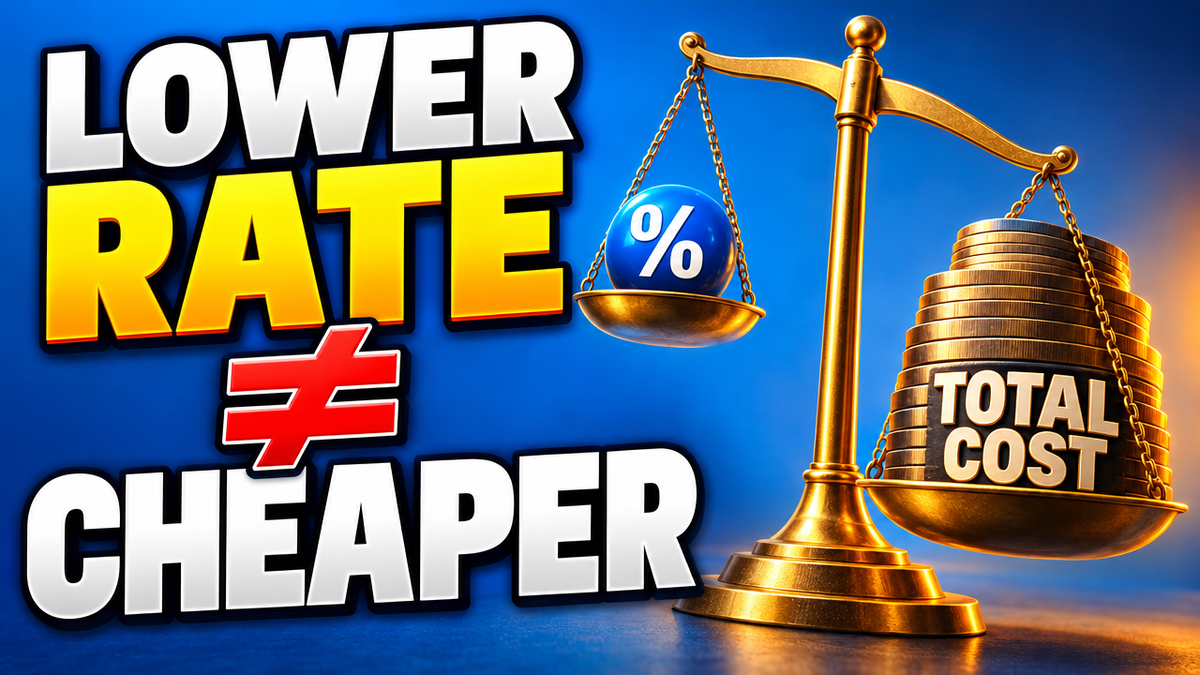
FHA versus conventional—which costs less depends on your credit, down payment, fees, mortgage insurance, and how long you keep the loan. FHA can cost less for borrowers with lower credit scores or smaller down payments, while conventional often costs less for borrowers with good credit and larger down payments, according to the Consumer Financial Protection Bureau. (consumerfinance.gov)
The recommended approach is straightforward: compare matched, dated loan offers—not just advertised rates. This November 2026 guide explains what to request and how to compare it without relying on an assumed refinance.
Start with the same borrower, home, and down payment
Ask for FHA and conventional quotes prepared on the same day using identical borrower and property information. Keep the down payment, loan term, and rate-lock period consistent, and clearly label anything that differs.
Use this comparison worksheet rather than filling gaps with advertised averages:
| Comparison item | FHA quote | Conventional quote |
|---|---|---|
| Quote date and time | Record actual date/time | Same pricing window |
| Home and purchase price | Same property and price | Same property and price |
| Credit and documented income | Same borrower information | Same borrower information |
| Down payment | Same dollar amount | Same dollar amount |
| Term and rate type | Specify term; fixed or adjustable | Match |
| Lock period and status | Record duration; locked or floating | Match |
| Interest rate and APR | Actual quote | Actual quote |
| Points, lender fees, and credits | Itemize separately | Itemize separately |
| Financed charges | Identify each charge | Identify each charge |
| Mortgage insurance | Amount and duration | Amount and duration |
| Total payment and cash to close | Actual estimate | Actual estimate |
No actual loan quotes were supplied for this article, so there is no supportable dollar-cost winner to declare. The CFPB’s comparison guidance recommends comparing Loan Estimates and ensuring that important loan features match. (consumerfinance.gov)
Compare the loan you can afford to keep—not a payment that only works if you refinance later.
Does FHA or conventional have lower interest rates?
Neither program automatically provides every borrower with the lower rate. Your credit affects mortgage pricing, and the CFPB recommends requesting both FHA and conventional quotes because the better overall deal depends on your circumstances and market conditions. See its guidance on credit scores and mortgage rates and FHA comparisons. (consumerfinance.gov)
A lower interest rate is not necessarily a lower total cost. Check:
- Discount points: Upfront charges paid for a lower rate.
- Lender fees: Compare their combined dollar total, not just individual fee names.
- Lender credits: These can reduce closing costs in exchange for a higher rate.
- Financed charges: Adding a charge to the balance does not eliminate it.
- Mortgage insurance: Compare both the payment and how long it continues.
The CFPB explains the points-and-credits tradeoff: one discount point equals 1% of the loan amount, but the rate reduction it purchases varies. (consumerfinance.gov)
Mortgage insurance can change the winner
FHA generally includes an upfront mortgage insurance premium and an annual premium collected monthly. Under HUD’s published premium schedule, standard purchase-loan upfront MIP is 1.75% of the base loan; for a loan over 15 years with a base amount at or below $726,200 and loan-to-value above 95%, annual MIP is 0.55%. (answers.hud.gov)
For newly originated FHA loans, annual MIP generally continues for the mortgage term when the original loan-to-value exceeds 90%. At 90% or less, it generally continues for 11 years, according to HUD’s MIP-duration guidance. Reaching 20% equity does not trigger the conventional PMI cancellation rules. (entp.hud.gov)
Conventional loans commonly require private mortgage insurance with less than 20% down. PMI pricing varies with credit and down payment, creating a potential conventional downside for borrowers whose insurance quote is expensive; see the CFPB’s mortgage-insurance explanation. (consumerfinance.gov)
For many conventional principal-residence mortgages, borrowers can request PMI cancellation at 80% of original value, subject to conditions. Automatic termination generally occurs at the scheduled 78% point if payments are current; the CFPB details the requirements and exceptions. (consumerfinance.gov)
That makes insurance duration—not just the first payment—essential to the comparison.
Compare cash spent separately from equity retained
Ask for comparisons at three years, five years, and ten years, plus your most likely ownership period. These are planning checkpoints, not predictions about when you should sell.
At each checkpoint, request three separate figures:
- Cash paid: Your purchase cash contribution plus mortgage payments and other ownership expenses.
- Financing cost: Interest, mortgage insurance, and loan charges, accounting for credits and avoiding double-counting financed charges.
- Remaining balance: What you would still owe at that point.
Do not treat every dollar of principal repayment as a financing expense. The CFPB’s five-year comparison method subtracts principal paid from the relevant payment-and-cost total to isolate interest and fees. (consumerfinance.gov)
For your longer worksheet, show the down payment and principal reduction separately from interest and fees. Hold property value constant for a baseline comparison rather than assuming appreciation, and account separately for selling expenses if you model a sale.
The practical FHA-versus-conventional “which costs less?” question becomes: Which option has the lower financing cost over my likely timeline, while preserving a workable cash reserve?
A $300,000 FHA purchase: what income is needed?
There is no reliable salary answer from the purchase price alone. Start with the arithmetic that can be supported without inventing a rate, household debts, or local insurance costs.
For an eligible borrower using FHA’s 3.5% minimum down payment:
- Purchase price: $300,000
- Down payment: $10,500
- Base loan: $289,500
- Upfront MIP at 1.75%: $5,066.25
- Balance if that premium is fully financed: $294,566.25
These are calculations using the CFPB’s FHA down-payment guidance and HUD’s upfront premium schedule, not a loan offer or approval. Financing the premium is addressed in HUD’s FHA handbook. Closing costs and prepaid expenses remain additional. (consumerfinance.gov)
To calculate income requirements, disclose:
- Principal and interest using the actual quoted rate and term.
- The lender-calculated monthly FHA premium.
- Property taxes based on the purchase.
- Homeowners insurance and any required flood coverage.
- HOA dues and applicable community or special assessments.
- Car, student-loan, credit-card, and other qualifying monthly obligations.
For a Bradenton property, use the Manatee County Property Appraiser’s tax estimator, which considers the property and applicable exemptions, rather than plugging in an unsupported countywide tax figure. (manateepao.gov)
The planning formula is:
Gross monthly income needed under a total-DTI test = total qualifying monthly obligations ÷ the lender’s applicable DTI limit.
The CFPB defines DTI as monthly debt payments divided by gross monthly income and notes that limits differ across products and lenders. Without the missing payment, debt, and underwriting inputs, a specific required income would be guesswork—not qualification. (consumerfinance.gov)
What does a 4% mortgage offer actually require?
A “4%” headline alone cannot establish whether that rate is available to you. No verified 4% offer was supplied here.
Before comparing one, request:
- The quote date, expiration, and lock period.
- Whether 4% is the permanent note rate or an introductory payment calculation.
- Points, lender fees, APR, and required cash.
- Credit, down-payment, occupancy, and property restrictions.
- Any builder, seller, lender, or program eligibility conditions.
- The payment after any temporary subsidy ends.
A temporary buydown subsidizes early payments; it does not reduce the underlying note rate, as Fannie Mae explains. For loans delivered under its applicable rules, borrowers must qualify at the note rate, not the temporarily bought-down rate. See Fannie Mae’s underwriting requirements. (singlefamily.fanniemae.com)
Your next step: compare actual Loan Estimates
Put two matched Loan Estimates side by side and work through this checklist:
- Confirm the property, down payment, term, and lock assumptions.
- Compare Section A points and lender charges.
- Identify financed premiums and other financed costs.
- Reconcile tax, insurance, and escrow estimates.
- Compare mortgage-insurance amounts and termination conditions.
- Review page 3’s “In 5 years” comparison.
- Request remaining balances and costs for your other ownership horizons.
These checks build on the CFPB’s Loan Estimate comparison process. (consumerfinance.gov)
Then choose based on a payment you can sustain and costs you understand. Treat refinancing as a future option to evaluate—not the assumption that makes today’s purchase affordable.
These materials are not from HUD, FHA, the USDA, or the VA. These materials were not approved by any government agency. They are independent of any government agency. We are not in any way affiliated with any organization listed or referenced within this website, including HUD/FHA/USDA/VA. The inclusion of various education, information, web links, or materials are not an endorsement of the Sender or any of its employees or business partners.
For information directly from HUD/FHA, visit https://www.hud.gov/guidance
For information directly from the VA, visit http://www.benefits.va.gov/HOMELOANS/
For information directly from the USDA, visit https://www.usda.gov/about-usda/general-information
Fisherman Mortgage Services LLC | NMLS #2398246 | Licensed mortgage broker, not a lender | Equal Housing Opportunity. Ian Anderson, Mortgage Loan Originator, NMLS #1849097 | (941) 746-5493 | NMLS Consumer Access: https://www.nmlsconsumeraccess.org/EntityDetails.aspx/COMPANY/2398246. This is not a commitment to lend. All loans are subject to credit approval, underwriting guidelines and program availability. Rates and terms are subject to change without notice.
Frequently asked questions
What is the downside of a conventional loan? +
Depending on your credit and down payment, a conventional loan may have less favorable pricing or expensive PMI. The CFPB notes that FHA can be cheaper for some lower-credit or small-down-payment borrowers, so compare actual offers rather than assuming conventional wins. Source: CFPB. (consumerfinance.gov)
Does FHA mortgage insurance disappear at 20% equity? +
Not under the conventional PMI cancellation rules. For new FHA loans, annual MIP generally lasts for the mortgage term when original loan-to-value exceeds 90%, or 11 years when it is 90% or less. Source: HUD. (entp.hud.gov)
Is a lower mortgage rate always cheaper? +
No—points, fees, and mortgage insurance can offset the interest savings. Compare total financing costs over the period you expect to keep the loan. Source: CFPB. (consumerfinance.gov)
How much income do I need for a $300,000 FHA purchase? +
The price alone does not determine the required income; your full housing payment, other qualifying debts, and applicable underwriting limits matter. Divide total qualifying monthly obligations by the lender’s applicable DTI limit for a planning calculation, then have the complete application evaluated. Source: CFPB. (consumerfinance.gov)

About the author
Ian Anderson — President | Senior Loan Advisor
NMLS #1849097
I'm Ian Anderson, and I founded Fisherman Mortgage Services because I believe owning a home is a fundamental part of the American Dream. I got my start in the mortgage business in 2019, spent three years learning the craft with a local broker, and in July of 2022 I launched Fisherman Mortgage Services so I could do this work my way — built entirely on word of mouth, realtor referrals, and treating every client like a neighbor. Credentials: NMLS #1849097; Fisherman Mortgage Services LLC, NMLS #2398246
More about Ian →Ready to talk numbers?
Schedule a 15-minute call. We'll walk through your situation and show you what's actually possible — no pressure, no pitch.
Book a call

